From Imagination to Reality: How Australian Creators are Pushing Frontiers with AI
The opportunities for Australian creatives are growing. In fact, generative media tools could help support up to 70,000 new roles in our local creative sector over the next five years, potentially contributing A$25 billion to the economy by 2035, according to a report by research agency Public First.
But behind these big numbers are creatives from different disciplines and industries exploring new artistic forms and processes with AI’s help. To help them bring their creative visions to life, Google launched the Create with AI Grant Program in 2025, working with five local artists - from the physical tactile world of sculpture to the emotional archives of family history. The artists used Google’s AI tools, including Gemini, Nano Banana, Veo, Flow, Lyria and NotebookLM, to realise visions that were previously out of reach.
1. Visualising a Father’s Memories: Clayton Jacobson
Filmmaker Clayton Jacobson has spent decades listening to his 86-year-old father’s stories of growing up in a traveling carnival. While the stories were vivid in his mind, Clayton lacked the visual archives to bring them to life—until now.
In his short documentary "Echoes of Home," Clayton used an extensive suite of Google AI tools, including NotebookLM, Gemini, Veo 3.0, and Lyria, to transform hundreds of hours of Covid lockdown interviews into a fully AI-generated film. By using AI to "de-age" images of his relatives, Clayton created a living archive where he could finally see the child living the moments his father described.
"I often will prompt it the way I would prompt an actor, where I’m giving it intent, I’m giving it sort of a roadmap, so it is a collaboration... The last time I was this excited about being a filmmaker, I was 17… I’m in that playground again." — Clayton Jacobson
2. Sculpting the Future: David Porte Beckefeld
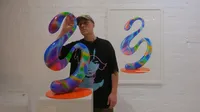
For Sydney-based 3D artist David Porte Beckefeld, the project "Future Relics" is a dialogue between human and machine. David began the process with his own VR sculptures and drawings, training Nano Banana Pro and Veo 3.1 on the unique traits of his artistic style.
AI allowed David to explore hundreds of iterations in an afternoon - forms that weren't limited by the physics of traditional materials. But the process remained deeply human: David curated the outputs, translated them into 3D models, and then meticulously hand-finished the physical prints with an airbrush to "close the loop."
"The hardest part of sculpture that this technology solves for me is creating new forms that I wasn't really able to think about or iterate upon previously... It’s kind of going from human to AI and then back to human." — David Porte Beckefeld
3. Fashion That Feels: Simone and Johannes Saam
What if your clothes could sense the mood of a room? This was the "grand idea" Simone Saam had 15 years ago, and now it has been brought to life through "Haptic Reality." This interactive installation features a garment that uses MediaPipe to read human body language and Gemini 2.0 Flash to run a "live creative brain."
As the wearer moves through their day, a camera senses the environment and triggers evolving textile designs on integrated AMOLED screens. By using Gemini 3 Pro to fill "emotional gaps" in the imagery, the garment becomes a reactive, expressive entity that bridges the gap between technology and empathy.
"Now using AI, we can really push and explore that technology and concept... It’s more about a collaboration that is getting us to an even higher level of creativity." — Simone and Johannes Saam
4. Harmony in Chaos: Kris Andrew Small
Artist and designer Kris Andrew Small is known for his bold, static works, but he always viewed film as the "apex of creativity." In his project "Symphonic," Kris stepped far outside his comfort zone to create his first abstract art film.
Kris led a team of ten human collaborators - musicians, painters, and cinematographers - and describes Google AI as the "11th member" of the crew. Using Flow as an "interpreter of an idea," he transformed a handful of stylized images into a three-minute journey through symbolic worlds. The technology allowed him to focus on the narrative and the "harmony within chaos" rather than the technical hurdles of animation.
"The Google AI tools have allowed me to come up with a concept that I wouldn't have done otherwise... the best use of any technology is when you mix it with something that’s truly human." — Kris Andrew Small
The New Creative Frontier
One of the most exciting things about any evolution in technology is seeing what’s possible in the hands of true artists and creators. For everyday creators, generative AI can act a bit like a digital studio assistant—handling the tedious tasks and potentially freeing up around 390 hours a year to just focus on the craft itself, according to the Public First report. By lowering the technical barriers, it could also give another 28,000 Australians the chance to turn a creative passion into a profession.
From David’s futuristic artifacts to Clayton’s emotional family archives, what’s apparent is that the artist's vision remains the heartbeat of the process - with AI as a tool that helps the creator express their imagination and bring their creative visions to life.