Accelerating Africa’s digital renaissance by investing in infrastructure and agentic AI

President Cyril Ramaphosa with Google leaders
Today, we hosted the inaugural “Building for Africa” Google Cloud Summit in Johannesburg, bringing together 2500 leaders, developers, and policymakers. Following the launch of the first Google Cloud region in Johannesburg in March 2025, we are proud to have already met and surpassed our $1 billion commitment to Africa's digital transformation ahead of schedule. A year later, African enterprises have moved past AI experimentation, stepping into the agentic AI reality of 2026, where AI systems deliver active, measurable business value.
The Agentic Enterprise in action
Agentic AI requires a unified data foundation. We see this in our collaboration with Vodacom. Vodacom is using Google Cloud’s secure infrastructure to unify its vast data assets. Now, by applying generative models like Gemini, the telco leader is establishing the essential framework to deploy autonomous agents that will power new, disruptive services tailored specifically for the African market.
This agentic AI transition is also reshaping wellness. Through Vitality AI, a platform created in deep partnership between Google and Discovery, the company is moving toward proactive, personalized interventions. Discovery integrates Google Cloud’s AI and data analytics tools with its own behavioral datasets to empower millions to take control of their health.
Another good example is Naspers, which leverages our Eastern Cape Hub for predictive, AI-driven commerce while adhering to South Africa’s POPIA framework, proving that rapid AI scaling does not compromise data privacy. Likewise, innovators like Revolut are using our AI Hypercomputer to seamlessly orchestrate complex operations. And Liquid C2 recently launched Africa's first Partner Experience Centre powered by Google Cloud in Johannesburg, empowering the local ecosystem to architect bespoke AI agents.
Investing in the foundation and the future
To truly build for Africa, we believe that we must invest deeply in grassroots innovation. During the Summit, Google announced five new initiatives building on our previous $1 billion commitment:
- South Africa Digital Exchange Port: We announced a new connectivity hub in the Eastern Cape province, the first of four connectivity hubs we committed to delivering to the African continent. This anchors the country as a strategic international switching point, connecting directly to Australia via the Umoja subsea cable and to India.
- Google Africa Applied AI Lab: In Ghana, Google AI Futures Fund and Google Research, partnering with leading VC firms, are opening Africa’s first Applied AI Lab. Founders receive early access to the latest Google AI models, and collaborate with Google experts to build AI-native solutions across work, knowledge, creativity, entertainment, and software development. Applications close August 31, 2026.
- Digital Innovation Centre: Google and WeThinkCode have committed to build a R3 million digital innovation centre at the George Tabor Campus of South West Gauteng TVET College in Soweto. Once complete, the centre will serve as a scalable skills platform built to reach talent the industry usually overlooks.
- Creative AI education: We partnered with The Akuna Group to empower underrepresented creators in Africa. Backed by more than $1 million (R17 million) in Google.org funding, the program delivers AI creative education alongside advanced digital tools. The program's goal is to equip African creators to tell locally rooted stories in new ways and forge professional advancement pathways.
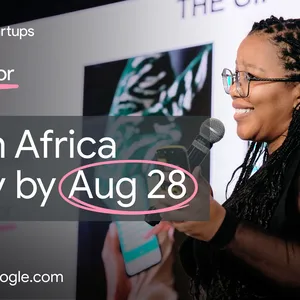
- Google for Startups Accelerator South Africa: Opening July 21, the 2026 cohort will provide 15 South African startups with an AI-focused curriculum and equity-free funding.
Looking ahead
The momentum across Sub-Saharan Africa is undeniable. Cloud and AI infrastructure is live, data foundations are unified, and the industry’s focus has shifted firmly to practical, agentic impact. African founders are building AI for African problems, and at Google Cloud, we are deeply committed to ensuring they have the trusted tools needed to define the continent’s autonomous digital future.