5 new ways Google is advancing sustainable innovation in India

Advancing sustainable innovation in India
As India accelerates its journey towards AI leadership, sustainable growth remains central to the country’s economic and environmental future. To support these priorities, we are announcing five new sustainability initiatives spanning climate-smart agriculture, climate technology, and clean energy.
Together, they build on our work with farmers, researchers, businesses, and partners to develop practical solutions to some of the country’s most pressing environmental challenges.
Scaling Solar API for over 300 million rooftops in India
Google has long used AI and imagery to make rooftop solar adoption faster and simpler. Solar API, part of Earth AI, can now generate insights for more than 1.2 billion buildings globally and 300 million rooftops across India.
The technology provides rooftop insights that let installers assess a home's solar potential without an on-site visit—reducing the time and cost required to produce accurate designs and final proposals. This comes amid a nationwide boom in Indian rooftop solar, fueled by government incentives.
Local solar platforms are already incorporating Solar API insights into their workflows:
- Solar Ladder, a domestic solar operations platform, integrates Solar API data to help installers prepare mobile proposals and reduce the need for repeated physical site assessments.
- OpenSolar, one of Google’s Solar API partners, uses the data to help installers model rooftop conditions and develop system and financial proposals for customers.
By making rooftop assessments faster, more accurate, and scalable, Solar API provides the foundational data to automate manual roof surveys and custom layouts—making residential solar faster, more affordable, and far easier for households across India to adopt.
Rooftop solar in Ahmedabad, Gujarat | Image credit - Getty Images

Adding 150 MW of clean energy to India’s grid
We are also expanding our commitment to India’s electricity grid through a new, long-term agreement with ReNew Power for a 150-megawatt solar generation project in Rajasthan. Under the agreement, Google will receive the environmental attributes associated with the clean electricity generated by the project and apply them to help address electricity-related emissions across our value chain.
This agreement builds on our approach to accelerate supply chain decarbonisation through the direct procurement of clean energy attributes. While we continue to prioritise engaging with key suppliers to enable their own clean energy, direct procurement allows us to cover the portion of our electricity emissions that cannot be traced to a specific supplier.
This marks our second Scope 3-focused solar project in India, which remains a key region given the significant concentration of suppliers operating in Asia-Pacific. Together, these projects are expected to add 300 MW of new solar generation capacity to one of the world’s most rapidly expanding grids.
Helping rice farmers reduce methane and conserve water
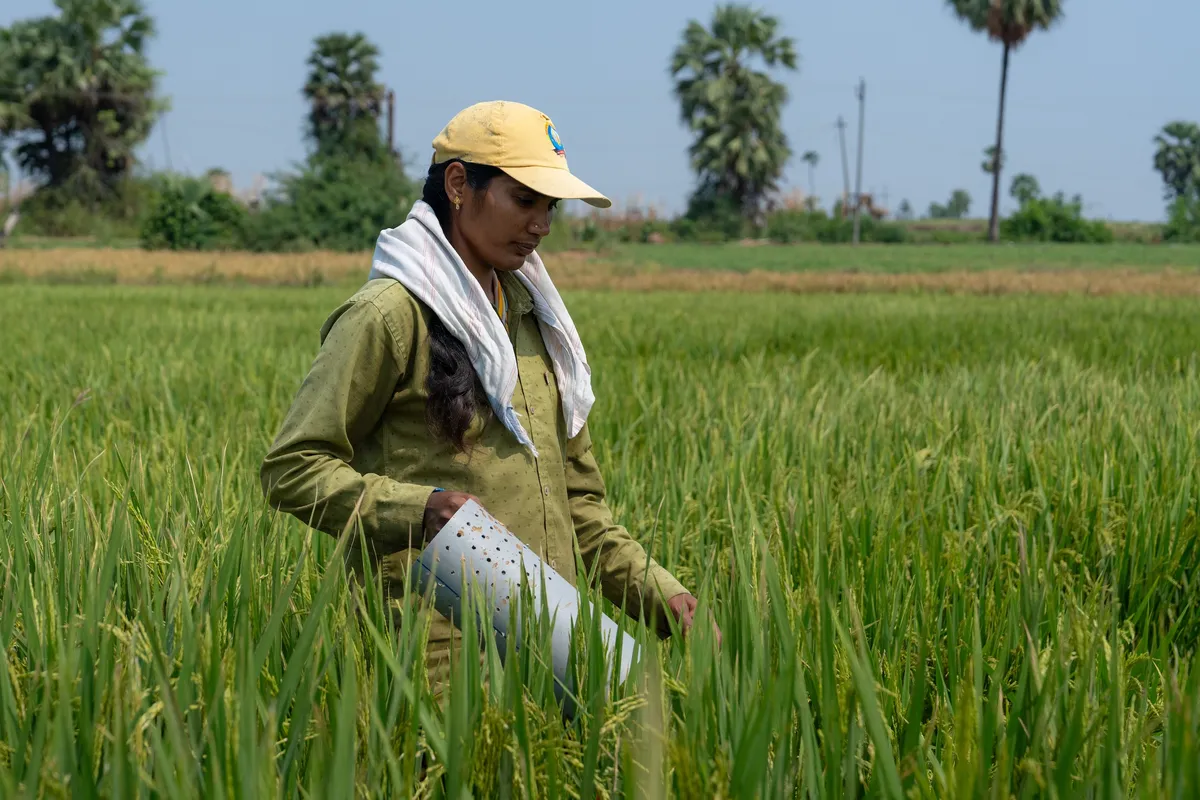
We’re partnering with Mitti Labs on a project that is expected to help tens of thousands of smallholder rice farmers adopt climate-smart farming practices. Globally, rice cultivation accounts for up to 12% of all methane emissions; in addition, once fully implemented, we estimate that this initiative will have the ability to conserve billions of gallons of water across regional basins in India and maintain crop productivity.
The initiative will introduce Alternate Wetting and Drying (AWD) across rice paddies in Telangana. Instead of keeping rice fields continuously flooded, farmers periodically drain and reflood them. This simple shift disrupts the oxygen-depleted soil conditions that generate methane—a potent superpollutant—while significantly reducing irrigation demand. Mitti’s approach combines methane reduction and lower water use with direct payments to participating farmers.
This is the largest publicly announced agreement to date to purchase credits generated by reducing methane emissions from rice cultivation. With this project, Mitti aims to have roughly 3 million tonnes of CO2e in near-term warming impact using a 20-year Global Warming Potential (GWP20) measure, which reflects methane’s stronger temporary warming effect in the near term. This is equivalent to 1 million tonnes of CO2e when measured over the conventional 100-year period (GWP100).
Mitti uses NASA-enabled satellite-based verification alongside its on-the-ground network to measure the project’s impact and support farmers as they adopt AWD.
As with our other superpollutant purchases, if Google uses these credits to counterbalance emissions, we will ensure they are either matched against shorter-lived emissions in our own footprint or replaced with carbon removals as their atmospheric impact expires.
Alternate Wetting and Drying (AWD) across rice paddies in Telangana will cut methane and reduce water use
Adding new focus areas to the Google Center for Climate Technology
Long-term environmental resilience also depends on funding research, accelerating technological innovation, and strengthening India’s green workforce. Launched in February in partnership with the Government of India’s Office of the Principal Scientific Adviser, the Google Center for Climate Technology (the “Center”) helps support researchers and innovators by applying AI to environmental challenges.
Out of 77 applications, the Center has now selected three inaugural projects evaluated on technical merit and projected impact across two tracks: green workforce training and low-carbon construction materials. These grants will support initiatives ranging from ready-to-teach courses and original research to pilot projects.
We are also expanding the Center’s work with two new focus areas and invite research and innovation proposals via the Manthan Platform:
- Water stewardship: Addressing rising freshwater demand by developing scalable technologies and management practices to protect and conserve vital watershed resources.
- Waste and circularity: Advancing research into e-waste and battery recycling processes and to support more circular approaches to resource use.
Selected and eligible applicants will receive support from Google to develop data-driven solutions in these new areas, helping translate cutting-edge research into practical solutions for the country.
Inviting proposals via the Manthan Platform for water stewardship and circularity

Supporting India’s climate tech startup ecosystem
Earlier this week, we welcomed the inaugural cohort of the Google DeepMind Accelerator: AI for the Planet, featuring four Indian startups leveraging AI to to solve environmental challenges:
- Terrastack and Varaha Climate, empower smallholder farmers with plot-level land intelligence, regenerative practices, and verified carbon credits.
- Farmers for Forests and Climitra Carbon, apply Geo-AI, drones, and satellite models to scale agroforestry, restore biodiversity, and convert invasive biomass into biochar.
These five initiatives demonstrate how combining foundational research, public partnerships, and direct support for local innovators can accelerate technological solutions that foster a sustainable, climate-resilient future for India.