Empowering African students and teachers with AI
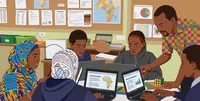
Curiosity is a winding path of questions that leads to new ideas and, eventually, to understanding. Across Sub-Saharan Africa, that curiosity is everywhere: in the student who stays after class to ask one more question, the teacher who experiments with a new approach, and the parent who wants something more for their child.
With over 60% of the region's population under 25, Sub-Saharan Africa is home to more of the world's young learners than anywhere else. By 2030, more than a third of the world's youth will live on the continent. For this generation, generative AI is becoming one of the most significant new tools for learning, with the potential to give every student access to personalized guidance. Harnessing that potential for African learners—thoughtfully and in partnership with people closest to the challenge—is one of the most important opportunities of our time.
Recently, the Education World Forum in London brought together education ministers and policymakers to explore this topic. Our conversations there reinforced a key lesson: progress is most powerful when it’s built with educators and communities, not just for them.
Measuring student and teacher success
To understand how our Gemini models impact student outcomes, we worked with Fab AI and local teachers on an eight-week randomized controlled trial (RCT) in Sierra Leone. The study involved nearly 1,800 junior secondary students in Grades 7 and 8 across 48 math classrooms.
Students who used Guided Learning, a tool that coaches them through problems, significantly improved their mastery of topics like fractions and exponents. They increased their scores on externally validated assessments by +0.26 standard deviations, which is equivalent to 1.2 to 1.7 years of typical learning progress in low-and-middle-income countries.
The average student used the tool for 15 hours, and those who reached the recommended 12-hour threshold saw even bigger gains of +0.38 standard deviations—effectively moving an average student from the middle of their class into the top third.
As one teacher told us, "With the introduction of Gemini, most students now love maths because the app is teaching them step by step." For a deeper look at the methodology and results, you can read the full technical report on the study.

Editor's note: These quotes come from focus groups with teachers who took part in the RCT and have been lightly edited for clarity and length


Empowering educators to do what they do best
Across Africa, teachers carry an enormous responsibility, often with limited resources and growing class sizes. For AI to be genuinely useful, it needs to reduce their burden and free up more time for the work only a teacher can do.
This is the thinking behind our partnership with UNICEF, supported by Google.org, which aims to support millions of teachers and students across Kenya, Brazil, India, and Pakistan with access to AI tools and training. In each country, the work is shaped by local communities and education systems to develop localized, scalable solutions that meet the needs of their students. In Kenya, UNICEF is working with the government and the Institute of Curriculum Development to integrate Gemini for Education and NotebookLM into the country's new curriculum. The goal is to give teachers better tools for planning lessons and to reduce administrative workload, so they can spend more time with their students.
Bringing AI tools and fluency to faculty and teachers globally
Beyond supporting teachers, it's critical to build AI literacy for the next generation. That's why we’ve partnered with the African Union Commission to bring Gemini for Education, NotebookLM, and related training to universities across all 55 Member States including the Kwame Nkrumah University of Science and Technology, the University of Ghana and Universities South Africa.
Together, we are working towards training at least 150,000 students and faculty by 2027. The African Union Commission's role in coordinating across the continent is what makes this kind of scale possible.
Redefining teaching and learning in Ghana with AI
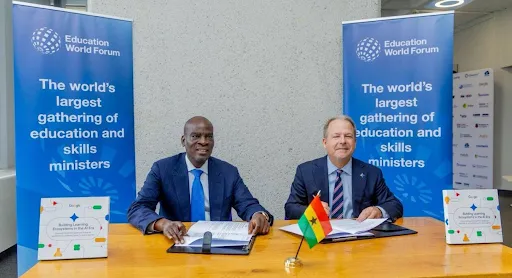
During the Education World Forum, we also signed a new Memorandum of Understanding (MoU) with the Ministry of Education of Ghana. This collaboration aims to integrate Google's advanced AI technologies into Ghanaian education to move beyond basic digital literacy and achieve true AI Fluency for both educators and learners.
Haruna Iddrisu, Minister of Education of Ghana, and Kevin Kells, Google for Education’s Global Managing Director, during the signing of the MoU at the Education World Forum.
The future of learning across Africa will be shaped by choices being made right now. When those choices center on the needs of teachers and learners, and when curiosity is given the space to do what it does best, something shifts. That is the work worth showing up for.