This content is generated by Google AI. Generative AI is experimental
[[duration]] minutes
Today, we're introducing TranslateGemma, a new collection of open translation models built on Gemma 3, available in 4B, 12B, and 27B parameter sizes. It represents a significant step forward in open translation, helping people communicate across 55 languages, no matter where they are or what device they own.
By distilling the knowledge of our most advanced large models into compact, high-performance open models, we have created a suite where efficiency doesn't require a compromise on quality.
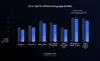
The most remarkable finding in our technical evaluation is the efficiency of these models. Through our specialized training process, the 12B TranslateGemma model outperforms the Gemma 3 27B baseline as measured using MetricX on the WMT24++ benchmark.
For developers, this is a massive win. You can achieve high-fidelity translation quality using less than half the parameters of the baseline model. This efficiency breakthrough allows for higher throughput and lower latency without sacrificing accuracy. Similarly, the 4B model rivals the performance of the larger 12B baseline, making it a powerful model for mobile inference.
We tested TranslateGemma on the WMT24++ dataset, comprising 55 languages covering a wide variety of language families, including high-, mid- and low-resource languages. TranslateGemma considerably reduced the error rate compared to the baseline Gemma model in all languages, achieving improved quality with greater efficiency.
How did we achieve this density of intelligence? It comes down to a specialized two-stage fine-tuning process that distills the "intuition" of our Gemini models into an open architecture.
We have rigorously trained and evaluated TranslateGemma on 55 language pairs, ensuring reliable, high-quality performance across major languages (such as Spanish, French, Chinese, and Hindi) as well as many low-resource languages.
Beyond these core languages, we pushed the boundaries by training on nearly 500 additional language pairs. We designed TranslateGemma to serve as a robust foundation for further adaptation, making it an ideal starting point for researchers to fine-tune their own state-of-the-art models for specific language pairs or to improve quality for low-resource languages. While we do not yet have confirmed evaluation metrics for this extended set, we have included the full list in our technical report to encourage community exploration and further research.
TranslateGemma models retain the strong multimodal capabilities of Gemma 3. Our tests on the Vistra image translation benchmark show that the improvements in text translation also positively impact the ability to translate text within images, even without specific multimodal fine-tuning during the TranslateGemma training process.
TranslateGemma sets a new standard for open translation models, balancing state-of-the-art performance with exceptional efficiency. Available in three sizes, these models are designed for diverse deployment environments:
The release of TranslateGemma provides researchers and developers with powerful and adaptable tools for a wide array of translation-related tasks. We are excited to see how the community will build upon and utilize these models to break down language barriers and foster greater understanding across cultures. Here’s how to try it: