This content is generated by Google AI. Generative AI is experimental
[[duration]] minutes
There’s an internal chat group where Googlers share all sorts of new AI demos. One day you might find a tool that recommends music based on a book you show it; another, an app that generates pics of your older and younger selves hanging out.
On many days, you’ll find the works of Google DeepMind UX Engineer Anna Bortsova.
Anna — who has a background in engineering and visual arts — loves experimenting with our AI tools. She has shared AI-generated alphabets with each letter made of intricate embroidery, and surrealist interpretations of popular digital games.
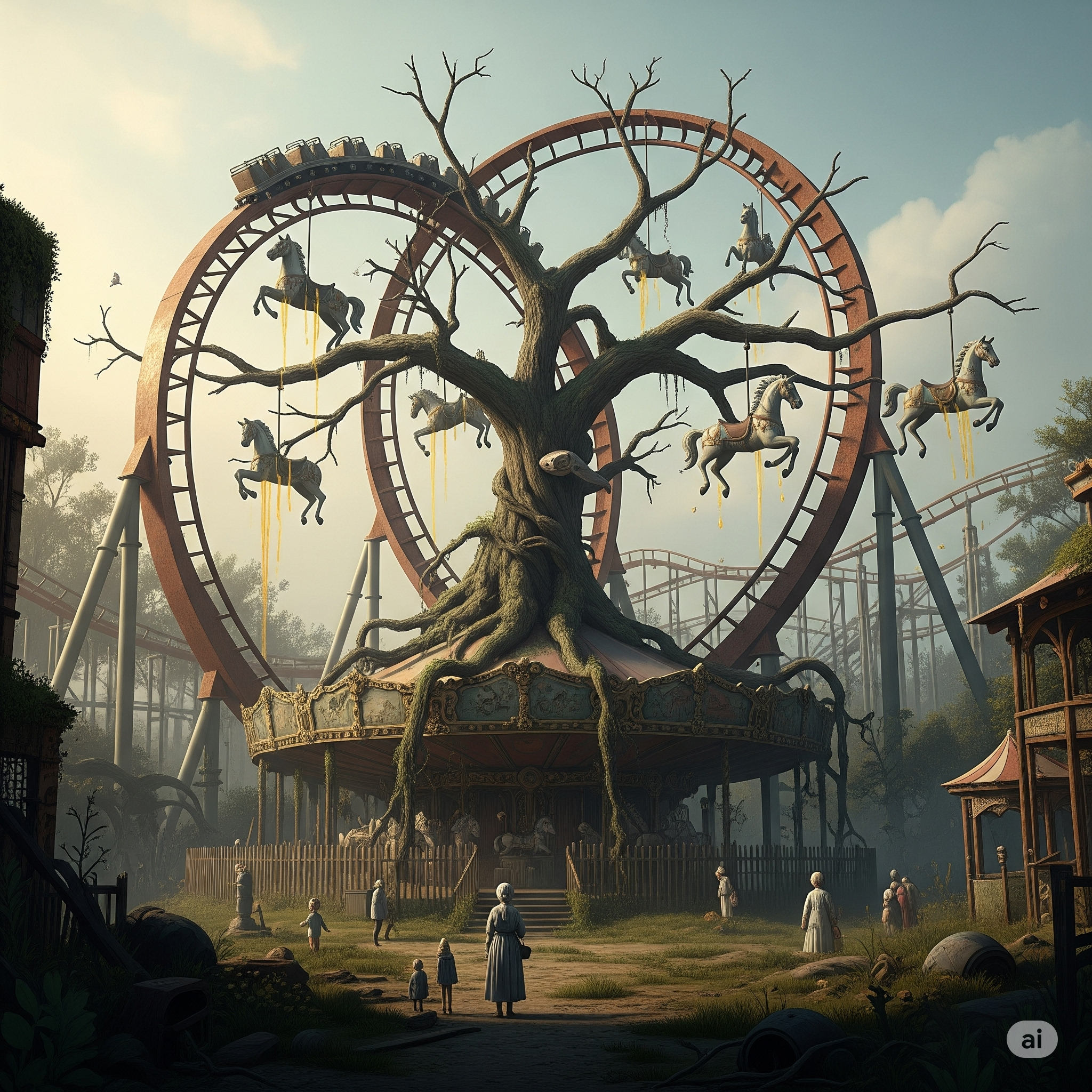
Surrealist imagery to ♥️.

Surrealist imagery to ♥️.

Surrealist imagery to ♥️.
Her background comes in handy. “I knew Salvador Dali was inspired by Flemish art, so I asked Gemini to produce surrealist images of the games in the style of Flemish artists,” Anna says. The resulting images went viral in the chat group, attracting emoji hearts and tons of positive comments.
More recently, Anna has used Veo to produce a series of short ASMR-style videos featuring stop-motion, paper-engineered scenes. She’s created videos of a skewer being barbecued — speared chunks of scrunched-up paper “meat” rotating above a mound of scrunched-up paper “coals” — and of a pink flamingo flapping its paper wings with a soothing flutter and whoosh.
“Veo 3 provides high-quality video and really strong sound,” Anna says. “There’s something so satisfying about the rustling of the paper in these videos.”
Others seem to agree. Not only have Anna’s creations been attracting serious emoji love in the chat, but marketing teams across Google have reached out to showcase her works on our social channels. She also posts her works on her own social media, where people from outside Google have asked for her prompting advice.
“The thing is,” Anna says, “Gemini is the one actually writing the prompts.”
Anna employs an approach known as “meta prompting.” Rather than writing a prompt for a specific scene, she asks Gemini to draft detailed prompts for several different scenes — sometimes 5-10 at a time — to use in Flow or the Gemini app. The resulting prompts can be incredibly long and specific — sometimes multiple pages — and result in breathtaking output. But the prompts she uses to instruct Gemini on how to create its prompts are key.
Anna’s meta prompts inspire Gemini to produce richly detailed prompts for instructing a gen AI model.
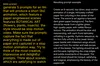
“There are no rules here — we’re experimenting — but I’ve found a few things that help steer Gemini to really rich prompts,” she says. “You want to define a very specific task: ‘write a detailed prompt that an LLM will understand.’ And you want to be clear about your format and style: say, an 8-second stop-motion animation of paper-engineered scenes. Then give it constraints, like foil paper or shiny paper, rather than just general paper. Then let it do its thing.”
Depending on how a model responds to Gemini’s prompts, you may want to tweak them, she says. Add or change details about the sounds and textures you want to produce — it’s a collaboration. You might also want to get emotional. “I’ve found it helps to suggest the feeling you want to evoke,” she adds. “Tell Gemini you want it to think about ‘scenes which are satisfying to watch,’ for example.”
With such instructions and the task of creating botanical art, Gemini delivered a prompt for an unfurling paper fern in which “the animation should be slow and mesmerizing, with each frond delicately unfolding in a gentle, rhythmic sequence.” Veo understood the assignment.
Anna’s ferns and feathers are not part of her core work: Day-to-day, she helps build the infrastructure and tools for Google DeepMind’s researchers to scale their AI experiments. But it’s something that gives her joy when she finds a spare 10 minutes, and she’s happy to share the love. (She even created a deck to pass on her learnings.)
Her biggest tip for Googlers… and anyone else who’s listening? “Pick a subject you love and just start experimenting,” she says. “That’s what I did, and I’m still learning — and having fun.”