This content is generated by Google AI. Generative AI is experimental
[[duration]] minutes
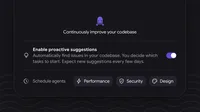
Every codebase collects a trail of small tasks, drift and maintenance work. It’s the work you intend to get to eventually, or the work you don’t notice until it slows you down. Imagine if your agent helped you carry that load without being asked to, every time. We are betting on proactive agents, ones that can carry that load for you. They surface meaningful tasks, prepare fixes you didn’t explicitly ask for and keep the system healthy in the background while you stay focused on building.
Today’s updates to Jules support your development lifecycle in this more sustained, intelligent and proactive way. This shift isn’t about replacing reactive features, though — it builds on them. Prompting remains how you steer. Proactivity is how Jules becomes a partner that thinks ahead.
We’ve seen the impact of this firsthand with the team building Stitch, Google’s AI design agent. They configured a "pod" of daily Jules agents using scheduled tasks, each assigned a specific role — ranging from performance tuning and security patching to accessibility improvements and increasing test coverage. This background work has made Jules one of the largest contributors to the Stitch repository, allowing the human team to focus entirely on complex feature work and creative problem solving.
Starting today, Google AI Pro and Ultra subscribers can enable Suggested Tasks on up to five repositories. This experimental feature continuously scans your code to propose improvements — starting with #todos comments — that you can review, approve or dismiss. We’ll be adding more use cases and higher limits soon.
Some work is predictable, like dependency checks or weekly housekeeping. With Scheduled Tasks, you can now define the cadence and Jules will perform the task at that time to help lower the cost of staying current, while keeping you in the flow.

Failed deployments and overflowed logs create a loop between the failure and the fix that often breaks momentum. Our new Render integration helps to close that loop. You can now connect your Render account with a single API key. When a Jules PR deployment fails, Jules steps in immediately, so you don’t have to copy and paste the logs into the prompt input. It analyzes the logs, identifies the issue, writes the fix and opens a pull request for your review.
You stay in control, and the path back to green stays short. This is step one in our quest of bringing Jules to wherever our developers are. We hope for intelligent development to be contextual across all your distributed workflows seamlessly.
Suggested Tasks begins rolling out today for Google AI Pro and Ultra subscribers as an experimental feature. Scheduled Tasks and our new Render integration are available to everyone starting today. You can try them now at jules.google.com — we’re excited to hear what you think.