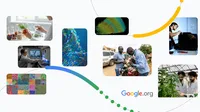
Science is the cornerstone of human progress. Yet, while the world’s problems are becoming increasingly complex, the pace of new discovery is actually slowing. To help overcome this, Google.org created a $20 million AI for Science fund to support academic, nonprofit and startup organizations using AI to tackle the world’s most complex scientific challenges. We're equipping researchers with the right resources to use AI to unlock the impossible and achieve in years what used to take decades.
Today, we’re announcing the twelve recipients of the AI for Science fund. These teams aren't just using AI to synthesize and process data; they are using it to break through the most significant obstacles across scientific domains like health, agriculture and biodiversity to turn discoveries into real-world solutions. Each of these organizations shares our commitment to open science. We expect their work to lead to open source datasets and solutions that can power breakthroughs far beyond their own applications.
Decoding the science of life and health
The sheer complexity of biological data has long been a barrier to medical progress. Five of our funding recipients are using AI to translate this complexity into a predictive, more precise science, moving us from reacting to disease to preventing it.
- UW Medicine is using its breakthrough Fiber-seq technology to build long-read maps of the 99% of the human genome that remains a mystery, aiming to unlock the genetic roots of rare diseases.
- Cedars-Sinai Medical Center is developing BAN-map, an AI-guided tool that analyzes neural data and adjusts experimental conditions in real time to maximize discovery within tight experimental windows and decode the neural mechanisms of thought and memory.
- Technical University of Munich is building a multiscale foundation model that bridges the gap between individual cells and whole organs, allowing clinicians to simulate disease progression and test treatments digitally.
- The Infectious Disease Institute at Makerere University is leveraging AI tools, including the "EVE" framework and AlphaFold, to predict how malaria-causing parasites evolve, helping researchers identify drug resistance faster.
- Spore.Bio, based in France, is revolutionizing microbiology and biophotonics with the development of an AI-powered scanner that could cut the time it takes to detect life-threatening, drug-resistant bacteria from days to under an hour.
Revolutionizing global food systems
A growing global population and a changing climate are placing unprecedented pressure on our food systems, from plants to livestock. These selected organizations are using AI to ensure that what we grow is more resilient, more nutritious and more sustainable.
- The Sainsbury Laboratory is launching "Bifrost," which uses AlphaFold3 to predict how plant immune receptors interact with pathogens based solely on genome sequences, accelerating the breeding of disease-resistant crops.
- The Periodic Table of Food Initiative (PTFI) is building an AI-powered platform to map the “dark matter” of food — thousands of unknown molecules that define nutritional quality and flavor — to help design and enable healthier diets.
- The Innovative Genomics Institute at UC Berkeley is decoding the microbiomes of cows, using AI to identify the specific interactions that can be edited to significantly reduce livestock methane emissions.
Protecting biodiversity and planetary resilience
Human activity is eroding the natural world faster than traditional science can document and understand it. These organizations are using AI to map, model and protect natural resources and drive breakthroughs in advanced clean energy and carbon capture. Together, they are building tools to safeguard the systems that sustain all life on Earth.
- The Rockefeller University is overhauling the genome sequencing pipeline with AI to automate data curation, accelerating the production of high-quality genomic blueprints for the planet’s 1.8 million species to aid in conservation and medicine.
- UNEP-WCMC is filling critical “data deserts” by using LLMs to scan millions of scientific records, creating a definitive distribution map of all 350,000 known plant species to guide global conservation decisions.
- The Swiss Plasma Center at École Polytechnique Fédérale de Lausanne (EPFL) is standardizing global fusion energy data and experiments, enabling AI models to learn from collective experiments and accelerate towards a reliable, carbon-free future.
- The University of Liverpool is reinventing the scientific approach with a "Hive Mind" method that connects autonomous laboratory robots with human scientists and AI agents to discover new materials for global-scale carbon capture.
Looking ahead
Whether it is curing a rare disease, protecting a staple crop or saving a species from extinction, these organizations are proving how powerful AI applications can accelerate the pace of innovation for everyone. We’re excited to continue supporting these organizations and discovering others that are driving breakthrough science. Google.org remains committed to accelerating the next frontier of scientific discovery–learn more about upcoming opportunities to join us in our mission to solve critical global challenges.