How we’re supporting the next generation of innovators


For decades, Google has supported Computer Science Education Week (CSEdWeek) to demystify coding and computational thinking. This year during CSEdWeek, we’re taking part in the global Hour of AI alongside our partners Code.org and the Computer Science Teachers Association (CSTA), to help educators and students better understand, use and create with AI. Towards this goal, we’re launching a new quest in our gamified experience, AI Quests, bringing AI literacy to classrooms with a hands-on approach, and we’re announcing over $5 million in Google.org funding for computer science teaching.
Launching a new quest
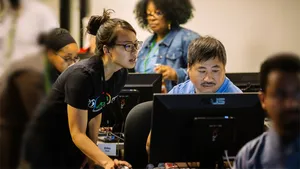
Hundreds of Googler volunteers around the world are visiting classrooms this week to lead AI Quests, our game-based learning series developed with the Stanford Accelerator for Learning. Today, we’re releasing a new quest where students step into the shoes of researchers and use an AI model to detect eye disease and prevent blindness. This quest is inspired by our real-world research on diabetic retinopathy. It can be accessed for free along with our existing flood forecasting quest and accompanying resources for teachers.
We’re also working closely with partners to bring AI Quests to more classrooms in 2026. One collaboration is with the Raspberry Pi Foundation and Google DeepMind, which has expanded their Experience AI program — recognized by UNESCO for promoting responsible AI education — to millions of students with funding from Google.org and integrated AI Quests into their curriculum.

Investing in educators
We’re announcing over $5 million in new Google.org funding to bolster computer science teaching in the age of AI. This builds on our recent $30 million global commitment to learning and foundational research, as well as the over $240 million we have provided to advance computer science education globally. The new funding will help organizations like California State University, Dominguez Hills to prepare teachers to deliver foundational computer science and AI curriculum to K-12 students and CSTA to publish the revised K–12 Computer Science Standards through a modern, accessible web-presence.
While coding tasks may change in the AI era, the foundational principles of computer science remain more vital than ever.