Google’s water stewardship commitments for local communities
Data centers are the nerve centers of the digital world, powering our daily lives with Search, Maps, online banking, healthcare and 911 systems. As we grow our data center footprint to support these services, we recognize that how we build is just as important as what we build.
Water is a critical component of data center development and operations. Because data centers generate heat from the servers and chips that power the digital world, they often rely on water to cut back on energy use for cooling. In many places, water cooling can reduce data center energy use by approximately 10% compared to air cooling. The aggregate water consumption of data centers is small — U.S. data centers use less than 1% of the water that Americans use on their lawns annually 1 — but we are focused on protecting local water resources in all aspects of our data center operations.
Today, we are announcing several water stewardship commitments as a promise to responsibly manage vital water resources where we build and operate data centers. Our goal is to minimize our local impacts so that our growth does not come at the expense of the communities we call home. We’re also announcing new water stewardship initiatives and evaluating projects through Google’s water replenishment Request for Information (RFI).
New water stewardship commitments
Under these five commitments, Google will:
- Replenish more water than we consume at our sites 2 by 2030. By investing in replenishment projects, we can help improve water security for everyone. In 2025, we replenished more than 7 billion gallons (roughly equivalent to the annual water usage of 70,000 average U.S. households). 3 And, today, we have 165 water stewardship projects across 97 watersheds. Once these projects are fully implemented, they are expected to replenish more than 19 billion gallons 4 of water annually by 2030, more than double our 2024 consumption (enough water to supply the entire city of Los Angeles for more than 40 days). The majority of these projects not only deliver volumetric benefits, but also help improve broader watershed health challenges such as water quality.
- Help modernize water and wastewater infrastructure for our neighbors. Water utilities are often underfunded. By working with our utility partners, we are helping update public water infrastructure so that our neighbors have reliable, affordable water sources both today and in the future. In addition to paying for the water we use, to date Google has committed over $500 million to the development of water, wastewater and water reuse infrastructure and to the utility partners that deliver water in the communities where we operate/build data centers. This includes projects ranging from enhancing local water supplies to detecting leaky pipes. We’re committed to continuing to help local utilities update their infrastructure.
- Protect at-risk watersheds with air-cooled solutions. We use a data-driven framework to assess local watersheds for new data centers before we build, and only consider water cooling if local resources are healthy and resilient. If a water source is at high risk, we choose air cooling or recycled water. We will continue to work in partnership with state agencies and local utilities to follow these principles and ensure our approach reflects community needs.
- Report our annual water use transparently. Water use shouldn’t be a “black box.” Google was the first major cloud provider to disclose our annual water use for our data center locations, and we’re committed to continuing to do so to ensure transparency for the communities where we invest and build.
- Pursue alternative and reclaimed solutions to protect water resources. We are working with utility partners to identify freshwater alternatives at our data centers, such as reclaimed wastewater. A prime example is in Douglas County, Ga., where we partnered with the county’s water and sewer authority to reuse treated wastewater for cooling at our data center campus.
Google’s water replenishment RFI
To further our replenishment goals, we’re also evaluating more than 700 projects submitted through our recent Water Replenishment Projects RFI. These projects include engineered solutions to improve water efficiency, supply or quality; farm-level practices to reduce agricultural water demand and improve soil health; and nature-based solutions aimed at improving the hydrologic cycle. We’ll have more to share in the coming months as we work with partners to roll out these projects.
Water is an essential natural resource that communities work hard to conserve. Through our water stewardship commitments, we will continue to be responsible and transparent in our water use — protecting the long-term health of the watersheds in communities we call home.
New water stewardship initiatives
Last updated: August 20, 2026
Our commitment to water stewardship has grown significantly. We’ve expanded our support to over 165 projects across 97 watersheds, and we’ve scaled our financial investments this year from $17 million to $77 million and our reach from 7 to 12 states across various water stewardship initiatives. Here’s a list of our latest water stewardship initiatives, and we’ll be updating this list on an ongoing basis.
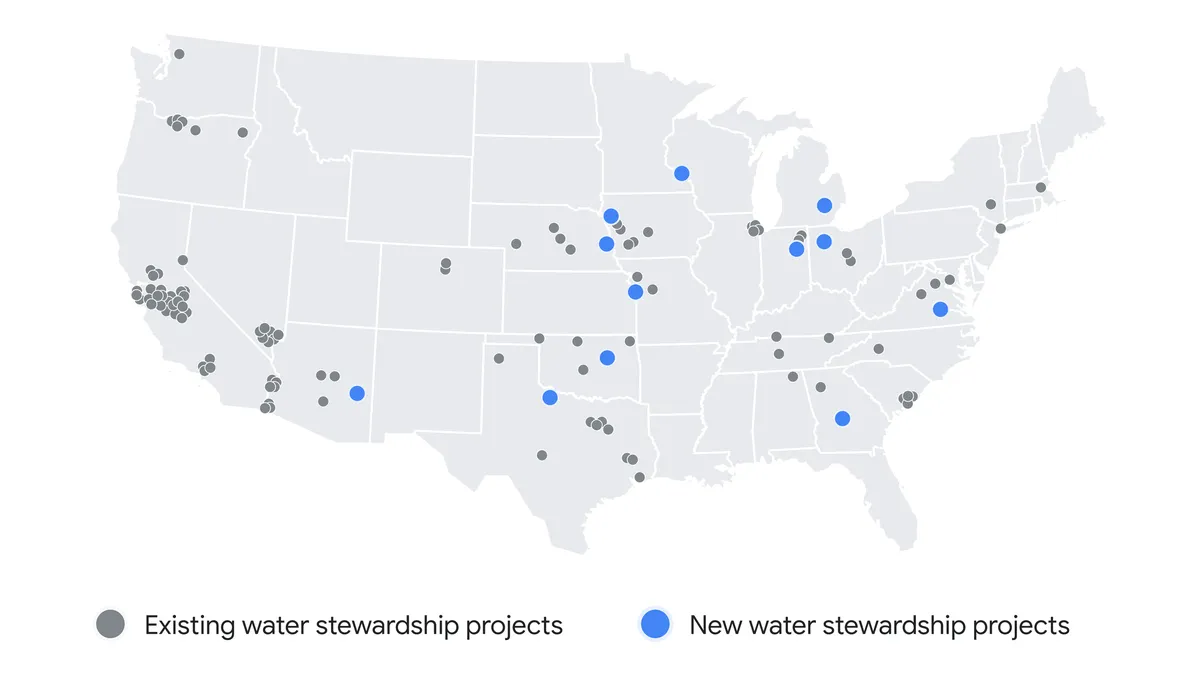
- Arizona: Trout Unlimited and the US Fish and Wildlife Service to remove and replace culverts that will restore natural streamflow and reconnect vital habitats for the Apache Trout.
- Georgia: Ducks Unlimited to enhance wetlands at the Flint River Wildlife Management Area.
- Indiana: Fort Wayne City Utilities to optimize water reuse at its water treatment plant, reducing withdrawals from the St. Joseph River.
- Iowa: The Great Outdoors Foundation and the Iowa Department of Agriculture and Land Stewardship to help local farmers in Western Iowa convert 5,000 acres into perennial hay and pasture systems, reducing fertilizer use and improving water quality.
- Michigan: Huron River Watershed Council to expand its green infrastructure program, using native plantings to treat stormwater and mitigate flooding.
- Minnesota: Trust for Public Land to restore 84 acres of floodplain forest, establishing a 1-mile corridor along the Zumbro River to improve water quality.
- Missouri: Bridging the Gap and the Heartland Conservation Alliance to restore 98 acres adjacent to the Blue River as a wetland, improving water quality and providing critical habitat.
- Nebraska: The Metropolitan Utilities District’s water line leak detection program in Omaha to help reduce water loss and improve system efficiency.
- Ohio: Department of Agriculture’s H2Ohio Farmland Water Management Program to optimize drainage structures to reduce agricultural runoff and conserve water.
- Oklahoma: Oklahoma Conservation Commission to remove invasive, water-intensive Eastern Red Cedar trees and restore cropland to native playa wetlands in the panhandle.
- Virginia: Frog Creek Partners to improve water quality throughout Virginia’s Chesapeake Bay and Roanoke River watersheds by installing stormwater filtration systems.
- Texas: Funding to support community water sources, infrastructure and access across the state.