Designing for privacy on intelligent eyewear

Nov 12, 2026

|

Our new intelligent eyewear can give you fast answers about what you see, all while staying hands free. Learn more about how we’re building eyewear designed to protect the privacy of you and the people around you.


Shahram Izadi

VP & GM, XR


Google G on a blue shield. In the background are various icons related to privacy: an eye with a diagonal line over it, a gear, an off button, etc.
Listen to article
[[duration]] minutes
This content is generated by Google AI. Generative AI is experimental

Intelligent eyewear with Gemini 1 can help you understand another language, make sense of a confusing parking sign, or know when to take the next step in your recipe, all thanks to its ability to see what you see. And with experiences like Guided Vision in Gemini Live, these glasses can provide audio descriptions to people who are blind or have low vision as they read small print or find everyday items. 2

But when technology can see the world around you, it has a responsibility to the people around you, too.

Throughout our years of research on glasses, we listened closely to wearers, bystanders, and privacy experts. We found that wearers were constantly calculating using glasses like these out-and-about during their day, while bystanders noted concerns about being filmed without their knowledge. This led us to the conviction that privacy protections on glasses must cover both the person behind the lenses and those in front of them.

Privacy designed for both sides of the lens

With this in mind, we set out to design the glasses so that personal help doesn’t come at the expense of anyone’s privacy. Here are some of the key features we’ve built into both the hardware and software to protect wearers and those nearby.
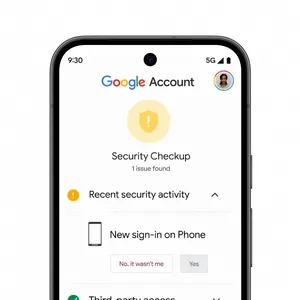
Protecting your visual data

  • Camera visuals aren’t saved in your Gemini History. When you ask Gemini on glasses about the world around you, like getting help translating a menu in another language, the camera visuals are not saved in your Gemini History. 3
  • Camera visuals aren’t used for AI training or ad targeting. The visuals Gemini captures are used to give you answers or get you the help you need. They are not used to train AI models or target ads.
  • Your data is encrypted. Data stored on glasses is encrypted, and if data leaves your glasses — like for processing on your phone or in the cloud — it’s also encrypted in transit to keep it private and secure. Coming soon, we’re also bringing Private AI Compute technology to glasses to process data in a secure, fortified space in addition to our other safeguards.

You choose what you share

  • You choose what apps can access your camera. Giving apps access to your glasses camera can be really helpful, like if you want to sync your audiobook app with the last page you read in your paperback copy. But before any app can access your camera for the first time, it asks for your permission. After that, you stay in control, and you can grant or revoke access anytime for each individual app.
  • You control your Gemini history. Your chats are saved in Gemini History so you can pick up a conversation where you left off and get more personalized help. You control your personalization and history settings, so you can review past interactions, delete individual chats, or even delete all of them. You can also control in settings whether the text of your chats is used to improve generative AI models. Learn more about how your Gemini data is handled in the Gemini Apps Privacy Hub.
  • Every pair has an off switch. And of course, you have a physical power switch on the frames to turn your glasses completely off whenever you want to wear them as regular glasses only.

Privacy protections for those around you

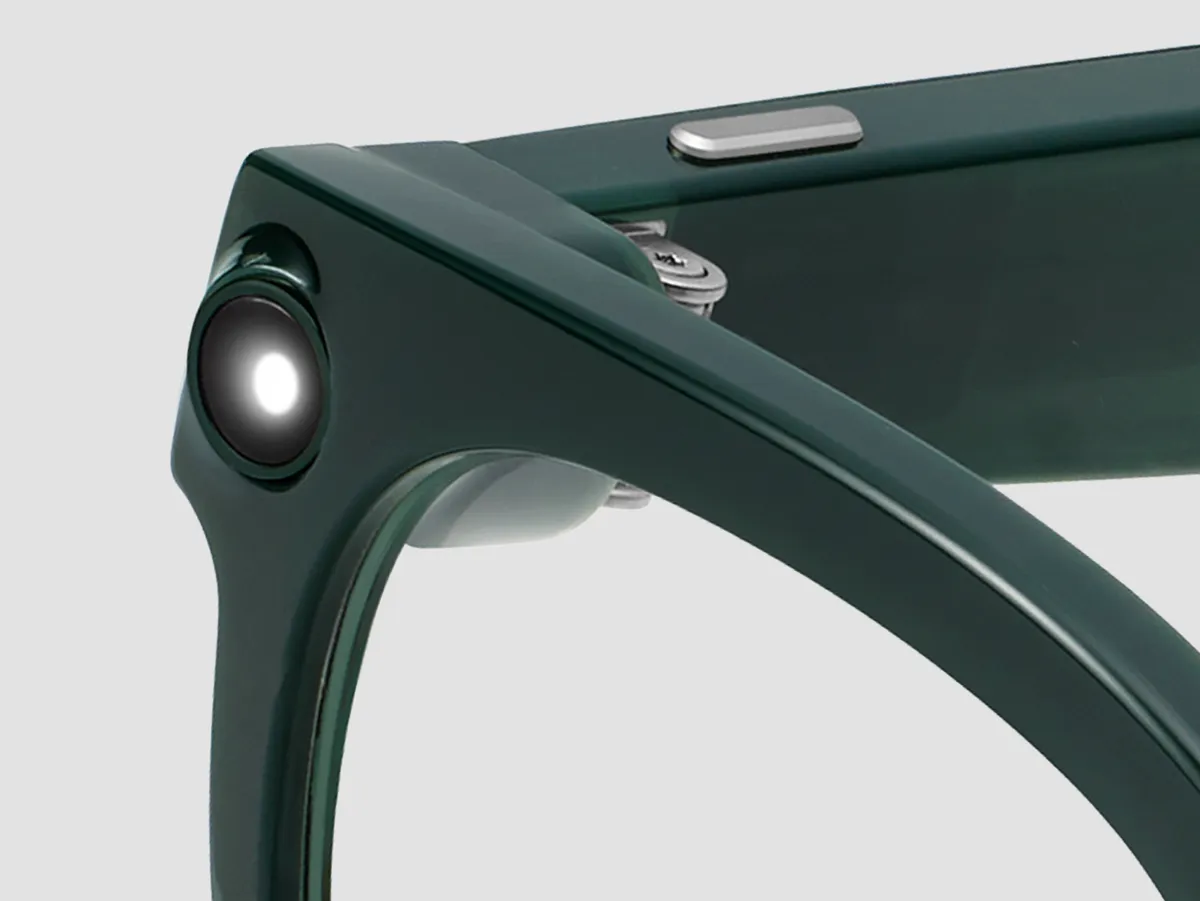
  • Every pair of glasses has an outer indicator light. We’ve heard from bystanders that the most helpful feature for them is a clear indication that the glasses are recording photos and videos. When you take a photo or video for your gallery, an outward-facing LED indicator lights up to let people around you know.
  • The indicator light is designed not to be messed with. If the indicator light is covered or tampered with, sensors are designed to detect that and prevent photos or videos from being taken.
Close up of a green pair of glasses shows an outer indicator LED light on the right temple.
  • The glasses are designed to redact faces before sending images to Gemini. When you ask Gemini a question, there may be others nearby. Not only are these Gemini visuals not used for AI model training, your glasses are also designed to automatically redact bystanders’ faces before Gemini processes the visuals.
  • Gemini is designed to focus on your voice. We’ve also designed Gemini to focus on your voice by default, and not other voices around you, using directional microphones on the glasses.

These are a few examples of the privacy features built into the intelligent eyewear experience. Learn more about our approach in the Google Safety Center.

Protections and restrictions across Google

In addition to these features, there are also protections across Google apps and services to deter misuse of the glasses.
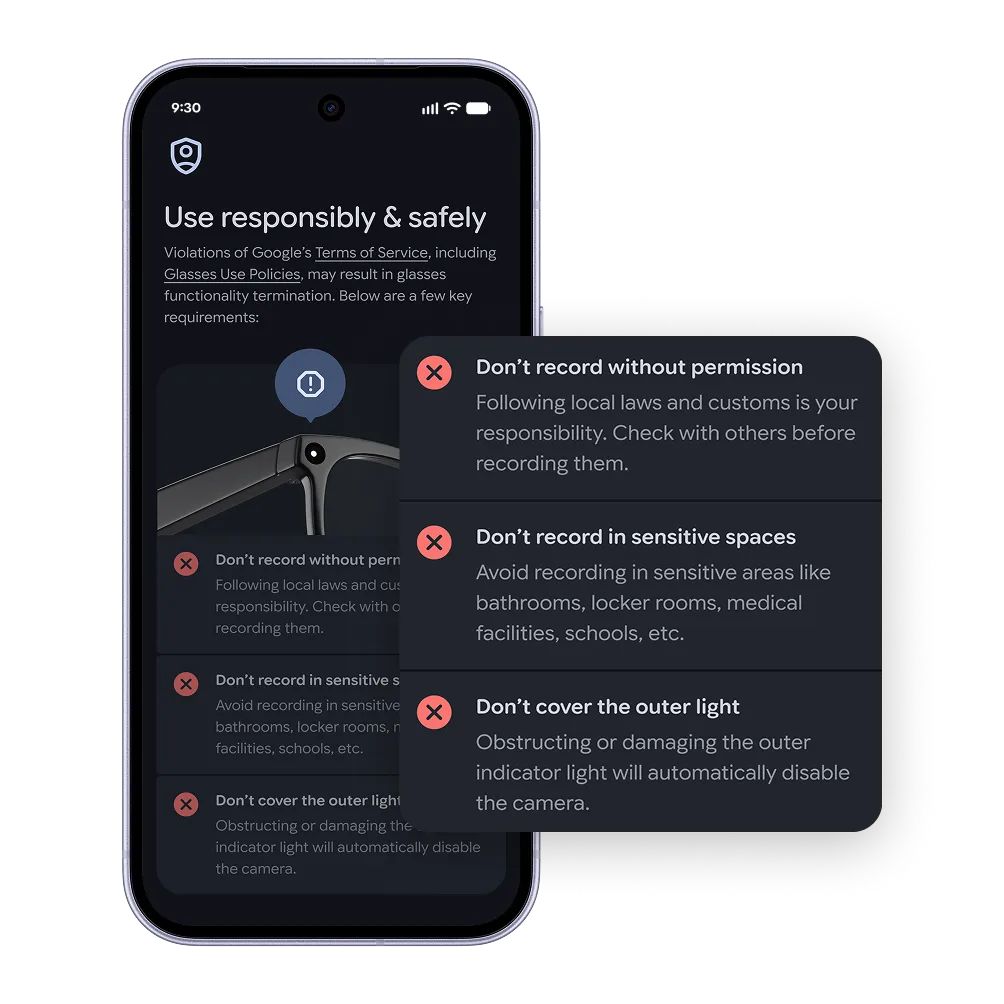
  • Responsible use requirements: Before using intelligent eyewear, users must agree not to record others without permission, not to record in sensitive places, and not to cover the outer indicator light. Not following these requirements is a violation of the Google Terms of Service, and a user’s ability to use the glasses may be disabled.
A screen from glasses set up outlines responsible usage policies.
  • Google Shopping and Google Ads: Policies do not allow the promotion of products and services that disable or hide recording indicator lights on smart glasses.
  • Google Play: Policies prohibit apps from using the camera for social live-streaming or real-time facial identification, and from changing the behavior of the outer indicator light.
  • YouTube: Policies prohibit content that depicts things like harassment and unwanted sexualization. Any video uploaded to YouTube — whether it’s recorded on a phone, a camera, or glasses — has to follow these policies, and videos that don’t are removed.
  • Account restrictions: Intelligent eyewear devices are designed to be set up only with compatible 18+ Google Accounts.

This is just the beginning. Privacy is foundational to how we design, build, and evolve wearable technology. As glasses become more capable, our focus is on creating helpful experiences that make both wearers and bystanders feel protected. We look forward to advancing this work in collaboration with privacy experts and others across the ecosystem to further protections for everyone on both sides of the lens.

Get the latest news from Google in your inbox

Sign up for our newsletters with product updates, event information, special offers, and more.

Your information will be used in accordance with Google's privacy policy. You may opt out at any time.

1

Setup and compatible 18+ Google account required. Available in the U.S. and Korea.

2

Available on intelligent eyewear paired to compatible Android devices. Guided Vision is AI and can make mistakes. It is not a medical device, clinical vision aid, mobility aid, or mobility replacement (such as white cane), and it’s not intended for navigation, safe-travel guidance, obstacle detection, or safety-critical tasks.

3

If you ask Gemini to take a photo or video, it will store it in your gallery.

About the Author

Shahram Izadi

Shahram Izadi

VP & GM, XR

Shahram Izadi is the General Manager and Vice President of XR at Google. He leads Google's Android XR efforts, overseeing the strategy, development, and execution of products and the underlying platform. His responsibilities encompass business, operations, product vision, design, and all engineering disciplines (SW/HW/AI) across various XR devices, including glasses, headsets, and phones. He also cultivates crucial partnerships with industry leaders like Samsung and Qualcomm. Izadi's career demonstrates a consistent drive for innovation in human-computer interaction and augmented reality. Prior to his role at Google, he co-founded and served as CTO of perceptiveIO, Inc., a Bay Area startup specializing in 3D depth sensing and perception. Google acquired perceptiveIO in July 2017.Before that, he spent over a decade at Microsoft in Redmond, where he held the position of Partner R&D Director from May 2005 to May 2016.

Read more from Shahram Izadi